
Football Development
The Problem With Subjectivity
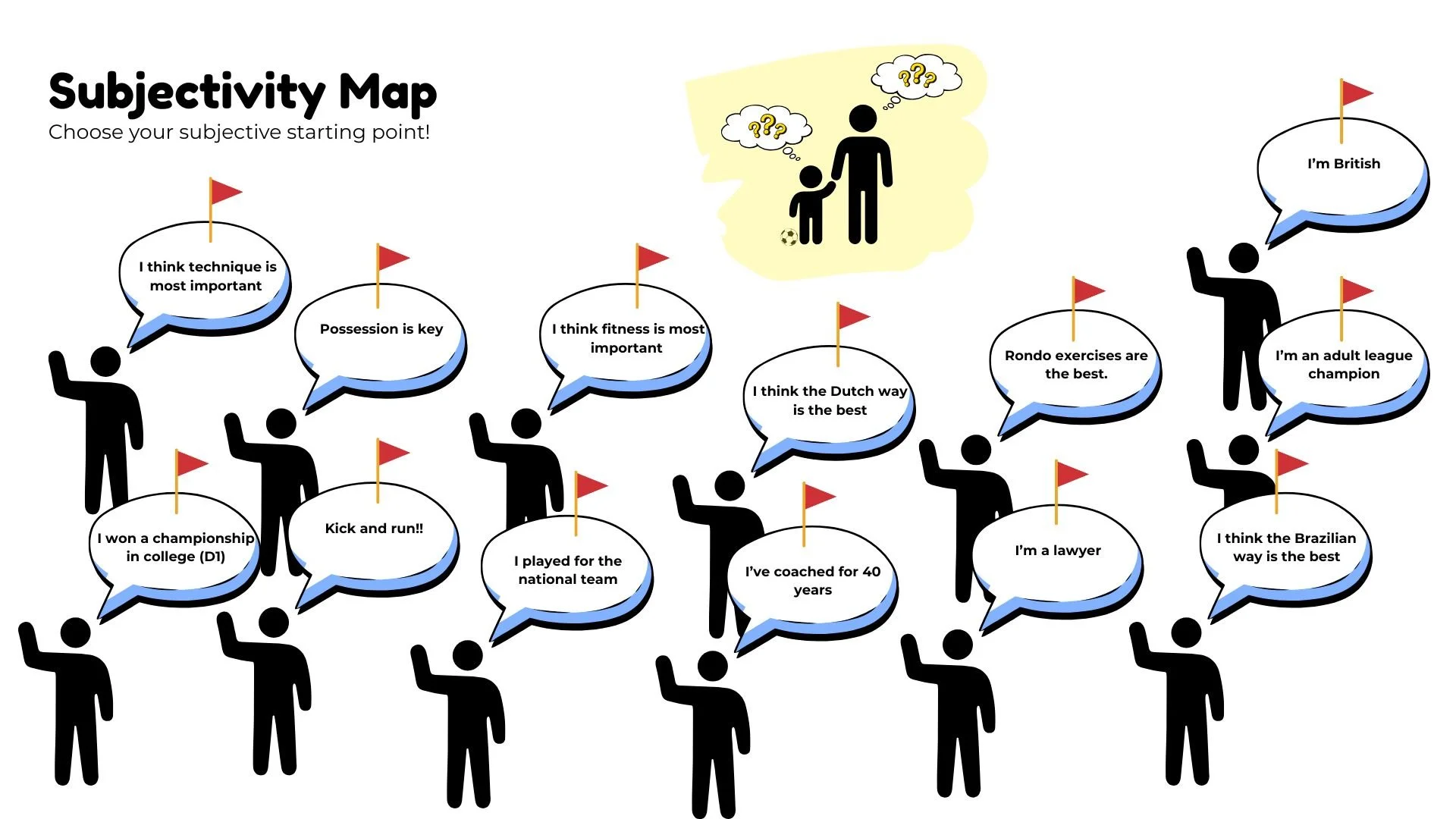
The image above shows a parent and child confused about which coach can provide proper football development. With so many subjective options to choose from, which one should they pick? The answer is: NONE!
Too often, clubs copy current champions, coaches rely solely on their past playing experiences, and parents value "experience" over actual knowledge. If the starting point for player development is based on subjective experiences, opinions and emotions, the chance of a player truly developing decreases substantially.
Subjectivity relies on a single, subject-centered perspective. To base players’ development on such a limited viewpoint is irresponsible; the sample size is too small, and there is no objective standard to measure progress.
For example, a club might choose to copy Barcelona’s methodology simply because they won the Champions League. Barcelona plays short corners to keep possession, so the club mandates that all their teams must play short. When the players ask, “Why can’t we just cross the ball into the box to Lil Johnny (a 6’5”, 13-year-old)?”, the coach replies, “We play short corners to keep possession like Barcelona, because they are the best in the world.”
The players know something is amiss but lack the explanatory theory to challenge their coach (or they do, but are too respectful to say so). So, they do as they’re told. Johnny never develops the ability to score off corners, nor do his teammates.
The club made a critical thinking mistake by making "possession" the objective. Research would have shown that Barcelona played short because most of their starters were around 5'7” and lacked aerial threats. Their tactic was a solution to a specific problem (height), not a universal rule. If they had possessed aerial threats, they would have put the ball in the box. We know this because the purpose of the game is to win, not to keep possession.
At Eagles RFC, our curriculum is objective and based on the characteristics of the game, universal principles, and facts—not subjective experiences, opinions, or emotions.